

1.4 — Take the tint
How the Brighton School gave film a “language” (1896-1907)

Here’s part 1.4 of my lopsided history of film. Yes, we’re still “stuck” at the turn of the last century; and—this week—we’re not even moving far beyond Brighton. But things will get more international soon; I promise. In this post I’ll be:
Introducing the “Brighton School” and its major players ⛱️
Showing how they pioneered not just the close-up, but some of the first colour films 🎬
Weighing up their influence and contribution to film language 📣
Bit of a lag with this post because I needed to chase down some archival materials; not least Sadoul’s book about the Brighton School (which I found in the British Library). I also had to go cap in hand to the Huntley Film Archives and the BFI Archive. More about that below.

If you’ve been following this history then you’ll already be familiar with the Brighton School. Both G. A. Smith and James Williamson were “part” of it, though this loose affiliation of Brighton-based filmmakers never saw themselves as a coherent group.
Looking back, Williamson was quite casual about its formation; describing it as a “coincidence” of their mutual residence in the town. It was natural to suppose that filmmakers—of whom there were so few in the 1890s—would congregate and share ideas. It was a very small world.
In this post, I want to revisit Brighton—and, sorry, Hove; its towny neighbour—in order to lay the foundations for discourses and dialogues that will become important in future entries of this history. Bear with me; I have not forgotten every other country in the world.

The “Brighton School” was first described by French film theorist Georges Sadoul, whose British Creators of Film Technique—translated and published by the BFI in 1948—gave theoretical bones to works made by the likes of G. A. Smith, James Williamson, Esmé Collings, and the engineer Alfred Darling; though this shouldn’t be construed as some kind of weird Franco-Brighton love affair but as part of Sadoul’s wider engagement with the history of film style.1 He found out about them by accident, though; some aside or half-mumbled mention that snagged on Sadoul’s mind. It was a hunch that took the Frenchman on a seaside day-trip to visit Smith and his contemporaries. Fun little scenario.


David Bordwell—bearded and chummy and very, very smart—provided the bigger picture when he glossed Sadoul’s thinking about these early film experiments; writing that “cinema developed artistic ambitions in the 1910s because it addressed itself to the bourgeoisie”. Sadoul was a Marxist, and he wanted to show how economic and class factors had a structuring influence on film’s evolution. It didn’t come out of “nowhere”. The same can be said of the Brighton Schoolers.
In searching for the roots of “film language”, Sadoul “[brought] forward the earliest British filmmakers as important contributors”; calling out their sleeves-up tinkering with close-ups, cut-ins, tracking shots and “camera ubiquity”.2 Here was the origin of a mature “film style”, and it would allow Sadoul to argue that films like Citizen Kane weren’t explosive aberrations but rather a bootstrapping of earlier innovations that were already half a century old by the time Welles and Toland got their hands on them. He would do the same for D. W. Griffith, hoisting him up as a great synthesiser of techniques rather than a lone, experimental genius.

So who were the Brighton School, and what did they actually do?
Let’s start with Alfred Darling, who Williamson, in his unpublished memoir, credits as being the major influence in drawing these characters together.3 He was a Brighton native, square of head and thick of moustache. Engineer by trade and early education. John Huntley—smilingly, with his film-scuffed voice and seat in the back row of a cinema during a very useful but almost impossible-to-track-down BBC documentary from 1966—tells us that G. A. Smith hit up Darling on a Monday morning in 1896 after seeing the Lumière films at a city screening. Darling sorted him out with a camera; a studio wouldn’t come until 1898. His garden provided his “stage” in the meantime. Painted backdrop type stuff; scrappily Victorian (willowy half imperial baroque).
Smith—who I introduced in my last post—had that Robert Frost look. When filmmakers sought him out in the 1950s, recording a brief interview with him, Smith had his hands planted on his fence posts—chin lifted up, eyeballing around, furze of white blossoming hair. Explains how he started with “natural subjects [actualities] . . . and then I went on to comedies”. Thick, tumbling voice; falling out in plummy droplets, a chortling laugh.
Elsewhere, it was Friese-Greene who allegedly got Williamson into the film racket; or so explains Williamson’s son in that 1966 BBC interview. Plummy, clipped, matter-of-fact. His father’s efforts came out of “bits and pieces”; it was all “odd shots” made out of 50ft lengths of film. Glass-roofed studios (but he dismisses the term), tracks for cameras, laboratory gear. It was a “one-man band”, but it grew in stature as time went on. They screened their stuff on Saturdays in a DIY-assembled “cinema” (really a kind of wooden affair with ornate painted backdrops); 6 shillings or whatever to get 15-minutes of film (“if you were lucky”, recalls one contemporary).


So we’ve got Smith and Williamson, but there’s also Esmé Collings to contend with. He was a partner of Friese-Greene in London, opened a photographic studio in Hove in 1888. In 1896 he began putting together a catalogue of films that were more-or-less facsimiles of what the Lumières were doing in France (crowd scenes, trains arriving at stations, beach bathers, etc), but people always like to talk about A Victorian Lady in Her Boudoir (1896); it was an erotic film. By 1898 or so he’d given up on film and moved back to painting; one of his earliest passions. Like many early filmmakers, he made a short and energetic contribution. But it was also a very important one.
Things were happening in the rest of the UK, of course. I’ll probably talk about this in a later post, but we can barrel along by mentioning the already-mentioned Friese-Greene as well as Robert W. Paul, Walter R. Booth, Will Barker, &Etc—all of whom benefited from manufacturers who were already apprenticing camera-builders in the late 1890s and early 1900s, or were manufacturers themselves.4 Devices got shared around, built on spec, commissioned, adapted. This was happening in Clerkenwell, mostly; where canny artisanal manufacturers were already fitting out shops and selling their home-brew wares to prospective filmmakers.


Together, Smith, Williamson, and Collings were among the first to systematically apply some of the devices and techniques that we now consider part of the furniture; including narrative, reverse shots, continuity editing, close-ups; and while Hove was a small place, film travelled easily. Edwin S. Porter was certainly aware of what they were up to; he paid attention and put their ideas to work. Everyone’s favourite Life of an American Fireman—a Porter-Edison film from 1903 —apes Williamson’s Fire! (1901). It might be “better”, but it wasn’t the “first” of its ilk. If that matters. I don’t know if it does.
I wrote about Williamson’s The Big Swallow in an earlier post, but his An Interesting Story (1904) offers an equal dose of corporeal silliness; featuring a man so absorbed in his book that he is run over by a steam roller; only to be inflated again by a pair of passing cyclists. Not too dissimilar from the antics that would make fellow Englishman Charles Spencer Chaplin famous in just a handful of years.
But there was one more trick that the Brighton School had up their sleeve, and it remains one of the most surprising culverts—because it has largely been forgotten—of early British film.

Enter Charles Urban. Here was a thick-jawed, slick-haired American—by way of Bavaria—who, arriving in the UK in 1897, set up the Warwick Trading Company; a purveyor of news-reels and actualities. He actually did a lot for British film; pioneering scientific movie programs at London’s Alhambra, filming a 2,500 ft film of “living London”, and being one of the first residents in what would become the heart of the British film industry on Wardour Street.
His relationship with G. A. Smith—hello again—was instrumental. Together, they’d pioneer one of the first colour film systems; perhaps even the first. Luke McKernan’s long and detailed piece about “Kinemacolor” is probably the thing you want to read if you’re really interested in this, but I can gloss the particulars for you here.
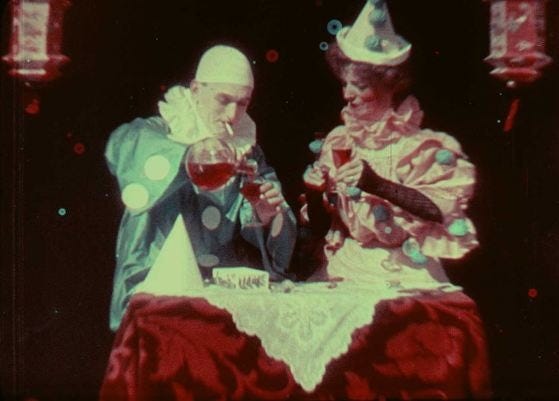
In 1903, Urban tasked Smith with trying to make the earlier Lee-Turner colour process actually work; it was notoriously “stubborn”, nobody could make heads-or-tails of it. Smith saw that a two- rather than three-colour approach had the best potential (red and green), and had sufficient chemical know-how to think about how to overcome the limitations of the colour-insensitive film stocks that dominated at the time.
Long story short, this meant creating his own panchromatic film stock; being one that was fully sensitive to the colour spectrum. It worked; and was patented in November 1896. The special camera that this stock required involved some kind of rotating red-green disc, but that’s as much technical bluff as I can give here. The best and most fun surviving example is G. A. Smith’s Two Clowns from 1906. You can watch it here; ciggies, conspiratorial whispers, glasses of booze. Clowns too, of course.
There was some further patent wrangling, and—despite Urban’s founding of the Natural Color Kinematograph Company—the system fell out of favour or was just sidelined and forgotten. Kinemacolor was groundbreaking, but it wasn’t easily scalable and uptake was resultantly limited. It made brief appearances in France, Austria, Germany, but quickly petered out. It wouldn’t be until the mid-1960s that colour film would become at all common; more than half a century after it was first invented.
The early cinema was bright; much brighter than the blackest-ever-black that defined the monochrome era that would eventually take flight. Tints were common; we’ll talk more about those in due course. Fire was red; daylight golden; the night a kind of primeval Klein-blue. Brighton was brightest of all; for a little while. Through colour and monochrome, they showed it all: granny threading her needle, the dramatized story of a fire brigade, seaside bathers, a kiss in a tunnel, a tale of Father Christmas, and even an imagined “attack” on a British embassy in “China” that was sufficiently realistic that its spectators believed it was a news reel.

In summing up the Brighton School, Bordwell again has the coup-de-grace; explaining how they “sought a total illusion incorporating movement, depth, colour, sound, and the sense of human presence”. This is really “it”, in a nutshell. They were early, they worked relatively independently, they were “small”, even if we can’t accurately say who was really “first”. But that doesn’t matter. What matters is their coherence and scrambling-tumbling inventiveness; meeting that perfectly imperfect tendency of Manny Farber’s “termite art” that I mentioned, off-cuffishly, in the introduction to this history.
They toyed around, got help where they needed it, made as much of a living as was possible. They were also mostly bourgeois, but that wasn’t the case for the technicians and apprentices who manufactured the camera devices the “school” relied on.
It wasn’t also the case for large numbers of their audience, who gathered together and watched The Kiss in the Tunnel—one of the first instances of continuity editing. Point-of-view shot from moving train about to enter a tunnel; cut to scene inside carriage where man and woman have an awkward kissy fumble; cut to point-of-view shot from moving train as it exits tunnel. Michael Brooke—a great source for commentary on these early British films—pads it down to Smith’s desire for “some extra spice” in the story. It wasn’t the “obvious” thing to do; but Smith made it obvious.
Williamson’s Attack on a China Mission (1900), meanwhile, introduced those same audiences to reverse shots; showing us the exterior of the under-attack “mission” (smoke, gunshots, panic) and then cutting to a scene of rifle-bearing sailors approaching the building. They fire their rifles right down the lens. We cut back to the front of the mission; the soldiers heroically save the day.
There’s a quote laying around by film theorist Alexandre Astruc, who argued that:
“The cinema is not an eternal art. Each of the aspects that it reveals is linked inevitably to the psychology of a period. Its successive faces vanish into the shadows when other ways of thinking rise up, when new techniques make earlier ones marginal”
The “psychology” of the early British film industry was its preference for running gags and sort-of slapstick tricks, where Smith, Williamson, and Collings all showed their best work when they weren’t just parroting films that were popular in France but were having fun with uniquely “English” amusements.
Unlike Méliès, these weren’t fantastical flicks in the magical sense. They mined the practical trickery of swallowings, deflations, and optical zoomings; creating a kind of everyday aesthetics of tomfoolery in which bodies were both troublesome and troubling. For Collings, that was a taboo strip act; for Smith, cannibalism; for Williamson, a physical deflation and the subject’s improbably-probable resurrection.
But this doesn’t mean that these films were “superficial”—a simple matter of surfaces. By colourising, distorting, reversing, looking close, the Brighton School played a role in the reassembling of truth that film lays its claim upon. Film truth; or kino pravda, for the “a little later” Russians. It has an “uncanny” truth claim (so Ute Holl says); where, even in its actualities, it was drawing attention to the already-seen, nudging it around. Remember: people paid good money to go and see themselves doing things that they might have done earlier that day in the “real” world. The cinema was different; and even the most indifferent of cinemagoers had glommed on to this. It was a “real” that wasn’t quite real, you might say.
The Brighton School were deflated too; in time. The cinema moved on without them. Sadoul tried to revive them first; and then Tristram Powell and his producer—a young Melvyn Bragg—had their opportunity. The thing about the history of film, as Astruc pointed out, is that its faces have a way of vanishing—just as others “rise up”. Not everyone makes it to the credits sequence.
But it would be incorrect to say—as others have—that Sadoul first referred to them as the “Brighton School”. His 1948 pamphlet calls them “British Creators”, and only makes passing reference to their living in the seaside town.
Bordwell’s On The History of Film Style (2018) remains really one of the best engagements with all these moments and debates; but his blog archive also features a wealth of essays covering a lot of the same ground.
Through all of this, I keep finding myself referring to but never properly introducing Robert W. Paul. In brief, he “invented” the film cut in 1898; linking two distinct shots in a logical, sequential order. Hopefully I’ll have a chance to return to Paul later in this history.
Brilliant breakdown of how Smith cracked the Kinemacolor problem. The bit about him going for two colors instead of three becuse of the film stock limitations was genius tbh. I've always wondered why early color took so long to catch on when the tech was technically there in the 1900s, and the scalability issue makes perfect sense.