

1.7 – Morality pays
The rapturous rise of Lois Weber (1913-1916)

Now my lopsided history of film is getting into territory where we’ll be spending time with individual filmmakers. Expect some jumping back and forth as we wade into the deeper waters of narrative filmmaking proper. Today, I’ll be looking at:
Lois Weber and her bananas formal inventiveness ⚙️
How she turned film into a politically-attuned pulpit ⛪
The falling-out-of-favour of cinematic moralism 🤏

In November 1939, Lois Weber—tall and dark-haired with a famously uplifted eyebrow—was admitted to Good Samaritan Hospital, Los Angeles in critical condition. Destitute and forgotten, she died two weeks later. Variety allowed two brief paragraphs for her obituary, and swiftly moved on.
It was a sad and lonesome end for one of film’s earliest and most ferocious agitators; a woman filmmaker whose career had surged and faltered through contracts with Universal and United Artists; her filmography numbering at least 78 productions (a number of which are lost).1
She was an actor-filmmaker who commanded millions in financing just as she “reject[ed] the values of capitalist America”. Her films were quasi-libertarian, papally-provoking morality plays softly brimming with what Kevin Brownlow calls a “quietness”, a “use of detail”, a “naturalism”. Not only were her stories real—morally inflected, finger-pointing, declamatory; they also sought to “charm the eye” and “leave a pleasant fragrance behind”. This would become an increasingly wonky tightrope for Weber to walk.


In the last estimation, Weber was a “picture missionary” who used film as a vehicle—often a sly and formally inventive one—to unpick and unstitch the moribund hypocrisies of her era and who saw silent film as a “voiceless language” that might give voice to real problems in America.
Three early films mark Weber out as a visionary apostle, and I want to spend today’s entry looking at this trio in depth. There are other films—the kind of movies she called “heavy dinners”—that demand attention, but I want to keep us locked in to the details. You might want to read Brownlow’s Behind the Mask of Innocence for a fuller estimation, a wider treatment.2

From the 1910s, Lois Weber—Pennsylvania born, middle class, devout—would carve a strange and ecstatic and palpably controversial path through early film. In her own words, “a real director should be absolute”—and her total filmmaking lives up to this claim.3 Maybe you’d call it auteurism, if that word had existed in the 1910s. You’d certainly call her agitational. It makes sense that she worked for Alice Guy in Gaumont’s outfit in New Jersey. She knew the movie business; inside and out.
In 1913, Suspense landed like a bomb. It is a kinetic and formally dizzying production that had an intuitive and vivid understanding of how to figure and disfigure such things as space and time—those oh-so uniquely cinematic fundamentals.
It is a “simple” film on its surface—a thriller which hinges on the proximate possibility of sexual violence. In it, a “wife”—played by Lois Weber – tends to her child at home while her husband—Valentine Paul—busies himself at his unspecified bourgeois office across town. Meanwhile, a third figure—Sam Kaufman—starts sniffing around the house. Here is the foundational triangulation of Weber’s film: an exposed wife, an absent husband, and a dangerous vagrant who is hellbent on getting inside and dot-dot-dot—who can say.
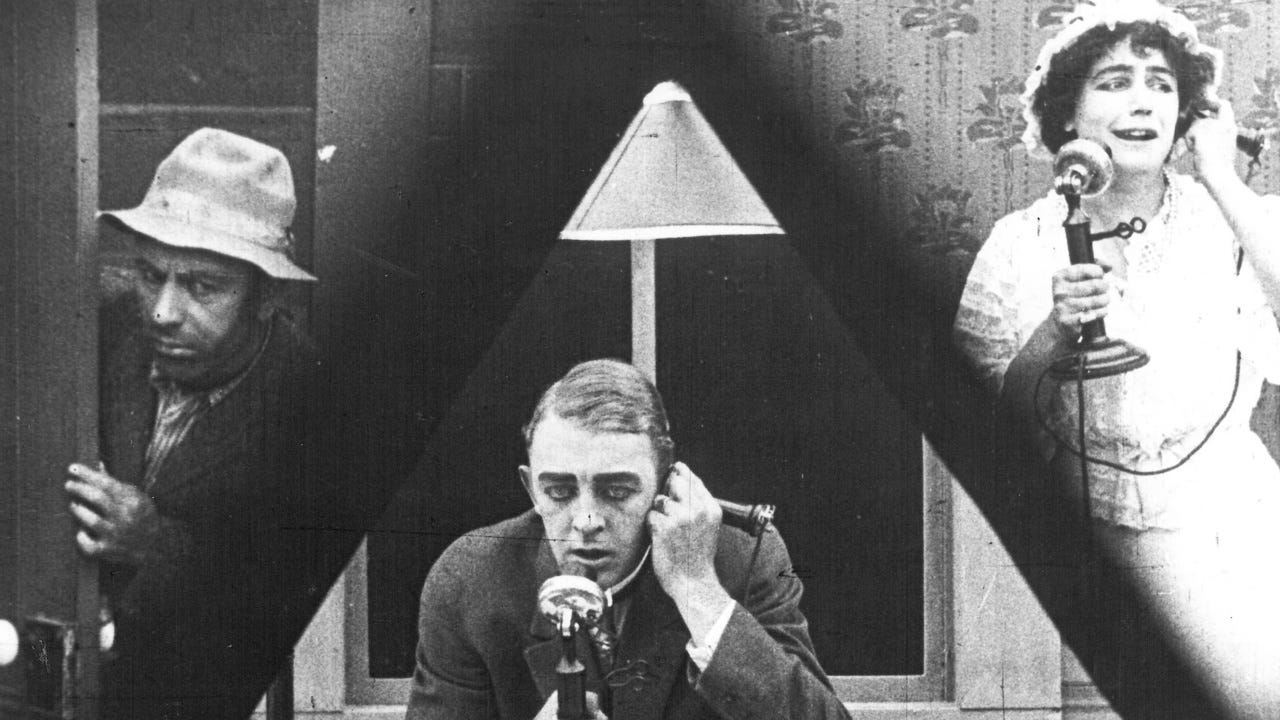
The wife gets wise to the vagrant’s desires. Here’s the tension: she calls her husband and communicates her angst and worry. Now he must make his way home—interceding in the transgression before it happens—while the vagrant tries to steal his way inside.
When I said “triangulation”, I meant it. Weber uses a triangular splitscreen to establish the parallel continuity of wife, husband, and vagrant. We see each of them in their cropped slice of frame: an invention you’d sooner expect to see in Leger and Man Ray. Now how she revs up the vagrant’s approaches to the building. First she frames down, over the rafters of the porch—a strange and uncanny angle. Later the camera is positioned—bird’s-eye—directly above the man’s head: he looks up, shunting his heavy skull back on his spine; locking eyes with the camera suspended over him. In later film parlance this might be used to suggest that the figure is somehow at risk, diminutive, puny; here it makes him feel alien and dangerous.


The husband’s chase is bottled lightning. Rushing, he hijacks an idling car outside his office which—oh la la—triggers a secondary chase made by clueless cops who don’t know why the husband performed this desperate act. The chase is dangerous: Weber’s camera is in the car with him, and the pursuing cop car is captured—convex and bulbous—in the husband’s wing-mirror. Parallel editing now: Weber switches back and forth between car-car-chase and vagrant approaching wife. He spies her through a keyhole—cue some very inventive keyhole-shaped masking.
Naturally, we know that the husband will get back in time; we know everything will “be alright”. Weber’s “suspense” isn’t about gratifying the audience with bloodshed, but establishing an alarmist bell-ringing anxiety centred on the flimsy protections offered by the home. It’s not the first time that the image of the “hobo” or vagrant was singled out with a sense of moral alarm in early film, and I’ve always been surprised how early these narratives kick in—having assumed that they would have been more common during the Depression.

But Weber wouldn’t eddy around her real moral concerns for too long. Now that films had begun to detach themselves from single reels, longer and more nuanced stories could be told. In Hypocrites (1915), Weber created a modern allegory for all the wanton doubletalk of the church and those putative people who call themselves its believers.
In format it is two things: a mediaeval parable that follows the martyrdom of Gabriel the ascetic—and a modern-day story in which a priest, played also by Courtenay Foote, likewise attempts to teach his flock about the purity of “truth”. Weber is taking a shot at clerics and the sluggish indifference of the church. Not enough piety, too much lip-service.


In effect, Hypocrites feels patient and holy; perhaps a little sluggish. Weber uses trembling, haliated lighting and black backdrops to pick out the face and body of the saint. Faces are framed in heads-and-shoulders; bodies are cast despairingly on the ground. What I really love about the medieval scenes is how Weber captures her crowds. Tracking shots on dollies patiently explore their faces and attire; slightly low-angled lenses fill the screen with cobbled-together mugs. The frame fills up; and Weber knew exactly how to exploit the frame—how to tilt the camera, which angles to set up—in order to lend her film a visual energy that, in 1915, was still really quite rare.
In the modern day story, Weber exploits a gigantically steep hill to effect the arduous course of the people’s bodies as they follow the priest up his dreamstate mountain. Many of them give up and wander away, while the priest experiences a dream in which he and the naked Truth go about revealing acts of hypocrisy in the world. Gamblers, cheats, sex-addicts; Truth holds her mirror up to them and sighs at their sinful audacity.
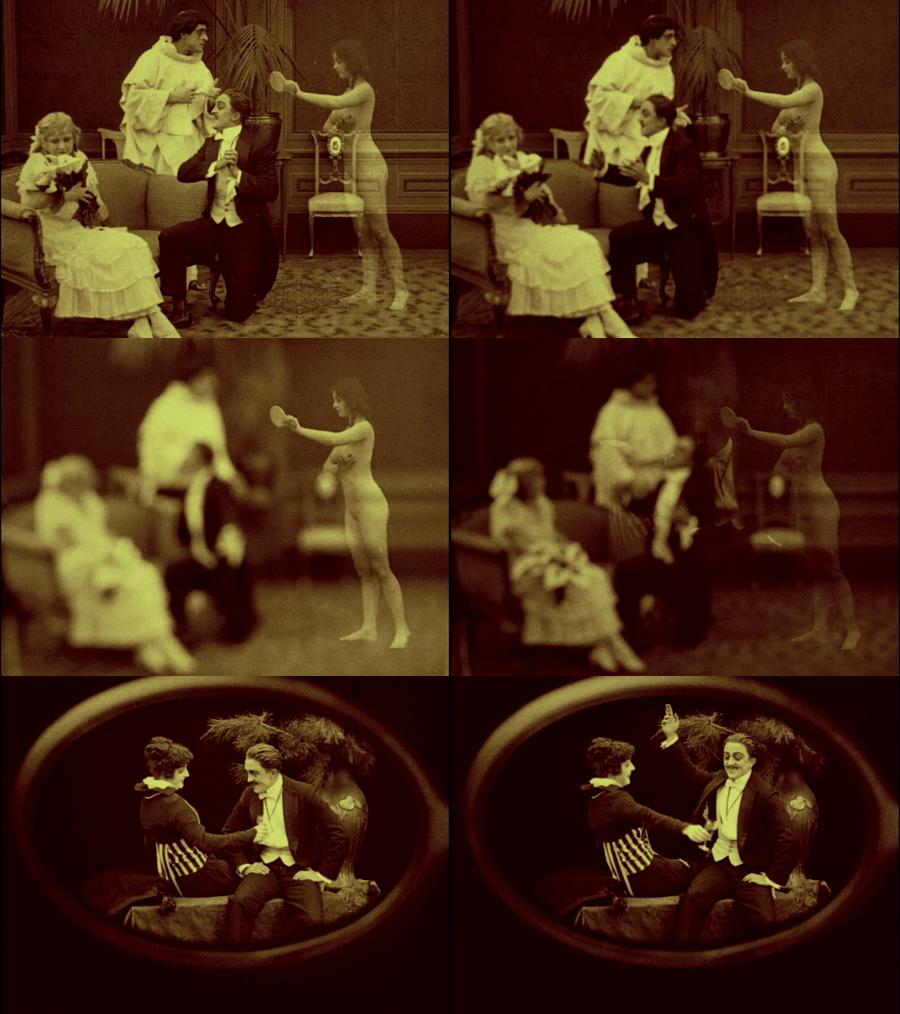
The film was censored, of course; thought too agitational against the church. It also featured a then salacious scene of full-frontal nudity—the first example of such in a film that wasn’t a porno. Margaret Edwards fulfilled this role. Weber shot these scenes on a closed set. There were riots in New York; it was banned in Ohio. The British Board of Film Censors, however, passed it without note. I don’t know what to take from that.

In Shoes (1916), Weber took aim at poverty and desperation. Eva—played stoically-despairingly by Mary MacLaren—is employed at a five-and-dime store on a tiny salary; and lives in a crowded home with her hard-working mother, gaggle of sisters, and layabout father. It was MacLaren’s first appearance; she’d go on to act for Douglas Fairbanks and Tod Browning, and would eventually appear alongside a young John Wayne.
The drama in Shoes revolves around Eva’s desire—as the title implies—for a solid and respectable pair of shoes; where her own cheap things are constantly falling apart in rain and sludge. Weber spends a lot of time showing Eva labouriously cutting out new cardboard soles for her shoes while fantasising about a lovely, proper pair in an upmarket shop window. We see these shoes through the window, spattered with rain and steamy with desire. These are Checkhov’s pumps.


The film itself goes like this: Eva is being courted by a caddish cabaret singer called Charlie. He wants her; she’s not really interested (or she’s too good and respectable to admit such feelings). But Charlie is willing to pay for Eva’s body – and this is precisely what comes to pass. With her money, Eva buys the shoes; only to discover—the next day—that her father has finally secured a job. If only she’d waited, &Etc.
Weber doesn’t blame Eva; she blames the iniquity of her situation—and she blames the men who leech off women; exploiting them passively and actively. That’s the moral “web” of Weber’s film, but what is so singularly powerful about this production is how Weber brought it to life through her dazzlingly coherent visual language.
Closeups are frequent; they jab into the film like hot knives through butter. Weber loves to show us Eva’s shoes—her toes pirouetting, the soles falling apart. In one memorable scene, it begins to rain; and we follow Eva’s footsteps with a ground-level pursuit shot as Eva’s weary, worn shoes splash through the water like a miserable metronome. This pair will be ruined; it is beautiful and devastating in a way that feels both obvious and audacious. Just like that moment when Eva prepares herself to sleep with the caddish Charlie; how she glances at the mirror, a crack across its face—splitting her skull in two. Weber says: Eva is broken, her innocence is shattered.


Domestic details were important to Webe; and she paid a care and attentiveness to even the smallest parts of everyday life. When Eva’s mother boils cabbage for the family supper, it is treated with a weighty gravity. Eva’s father—the out-of-work layabout—isn’t really bothered about the woes of his family. At the dinner table, he “props his book against the sugar-bowl”—indifferent and blind to Eva’s ragged feet.
In many of her films, Weber preferred the use of real domestic spaces; and what we’re seeing is an actual working-class home rather than an imagined “set”. Everything feels more real, more lived-in, more used. Everything is askance; of bodies, tables, counters, furniture.


In Weber’s universe, nothing is glamorized. This is real life. When Eva makes her heavy, steady, tired way up the stairs of her building, Weber’s camera meets her body and pans to the right—thickly. It feels weighted down. Her body, sick with influenza, slumped in her rocking chair; her feet in a bowl of warm water. The way her body crumples into itself when Charlie takes her hand at the nightclub table. These moments congeal the frame. We also get attentive and detailed cutaways that shift the angle, draw attention, underline; right out of the rulebook that Kuleshov hadn’t even written yet.

Lois Weber was an ideologue, an agitator; I half think that she was closer to Shumyatsky—the head of the Soviet Union’s Soyuzkino film organisation in the 1930s—than she was to a totally freeform filmmaker. This isn’t a dig; Weber looked at the conditions of real working people—and she looked at the spiritual malaise that she saw affecting the US— and she launched an electric broadside against it. It gets heavy, sure; sometimes too on-the-nose. The double-exposure of Shoes when Eva—tossing and turning in bed, wracked with worries about her family’s dire situation—sees a gigantic grasping hand with the works “POVERTY” marked on it reaching over her head. I had already been telegraphed this point; it wasn’t necessary to literally spell it out.
In many ways, Weber was a difficult reformer; and it’s not easy to understand the subtle and often contradictory currents that pass through her films. Indeed, the “problem picture” had become an (un)popular bête noire by the 1920s; insufficiently entertaining, too dogmatic. Who’d want to go to the cinema just to be lectured? Kevin Brownlow puts it this way: “Countless social or message pictures had played on people’s sense of outrage, and they had grown tired of feeling ashamed or indignant when they went to the movies.”
Even then, Weber was among the best of the moralists and problematisers; she had an intuitive and inventive understanding of the cinema and had the sensibility to fold her morals into an appetizing bite. Weber herself said that she didn’t want to crowd the box office with the “promises [of] red lights”. But this statement feels somewhat disingenuous; the full-frontal nudity in Hypocrites certainly did pack the houses, just as her bruising reputation ensured no small amount of controversy. Intended or not, she got people talking about her films and—for some years in the 1910s and early 1920s—coming through to sit down and watch them. The Blot (1921)—through its depiction of “genteel poverty”—is perhaps her masterwork; Where are my children? (1916) addressed the sensitive subject of abortion. She was unrelenting; she saw her films as an “editorial page”.
Eventually, however, her career began to falter; after her divorce from Phillips Smalley in 1922, with whom she’d collaborated on so many films, she became an alcoholic. Her audience faded away, her company failed. During the cynical 1920s, there was too little oxygen for films that bore their finger-wagging moralism too heavily. Lois Weber faded from memory.
Here’s the rub; in some sources, Weber is credited with having filmed 200 productions—a not too unsurprising number given the frenetic energy that surrounded early silent film, but it’s still a huge and towering legacy. Even then, maybe only a tenth of these are known to survive today.
You can also read her insanely expansive Wikipedia entry, which has hundreds of references. If Weber was forgotten by her contemporaries, she’s by no means a digital “ghost”.
I’m quoting from this piece on Criterion by Pamela Hutchinson.