

1.14 – Lost, lost, lost
The obliterated fates of Futurism's first abstractionists (1911-1916)

The films of Bruno Corra and Arnaldo Ginna no longer exist. They form part of the immeasurable fundament of cinema’s ruins. Early film stocks were perishable, burnable, degradable. The convulsions of the 20th century—with its wars and genocides; its archival re-assemblings and silencings—did away with great stores and archives of films that first existed, and then no longer existed. What survives today represents a kind of archaeological sludge-record-detritus made up of things that were lucky or mass-produced or both or neither.
It’s hot right now in London. It’s hot everywhere. Putting aside—inescapable, correct, suffocating—all these timely-timely gestures toward the climate crisis, I’ve started thinking about the not-so-long history of film and how difficult it is to watch a film when it is very hot; all stuffy and needling and amorphous. The “lost” films of Corra and Ginna—and the lost films of every other “lost” filmmaker—become the perfect antidote to too-much-hotness, if for no other reason than they cannot be seen, that they escape the eye, that they resist the indexical absorption of “Looking” and instead become (or already are) objects of distant rumination, rather like the thought of sky-splitting rain during a summer drought; a rain that will never fall, cannot fall, cannot even be imagined to fall. In the schmerz of the great English heatwave, I close my eyes and think about films I cannot ever see. I can do this outside; cooling myself in the shade of a tree.
They—the films of Corra and Ginna—were bombed out of existence. Let me get that clear. During WW2, what existed of Futurist cinema—because they were Futurist filmmakers, in their way—was almost entirely obliterated by Futurist bombs; or, by the kinds of bombs and bombing the Futurists so gleefully reified.
But let’s describe what we can describe. Detail, allusion, adjacency, context. If the lost films are indeed lost then what remains of them? Surely something, else I wouldn’t have mentioned them in the first place.
Corra and Ginna were probably the first filmmakers to experiment with a kind of pure abstraction; scoring and painting directly on the film strip in a way that would anticipate the work of Stan Brakhage on the far side of the Second World War. It feels fitting that Brakhage’s most extensive exploration of painting-film-abstraction was an “adaptation” of Dante’s Inferno—a perhaps winking but probably unintentional recognition of his Italian progenitors.
The collaborators—both Italian—were at first close to and then functionaries of the Futurist movement; besotted and beholden as they were to a materialist/ic, formal, motional cinema over what Peter Gidal would later call the “narrative (dominant) cinema”; the cinema of illusions. Here we might differentiate what they were doing from the work of Émile Cohl, a Frenchman, their contemporary, whose works—which do survive; at least in part—were concerned with a kind of “representational hallucination”; half akin to a proto-Surrealism, the works of the Incoherents. Fantasmagorie (1908) is the prototypical Cohl. But he was unlike Corra and Ginna; I think you can see how and why.
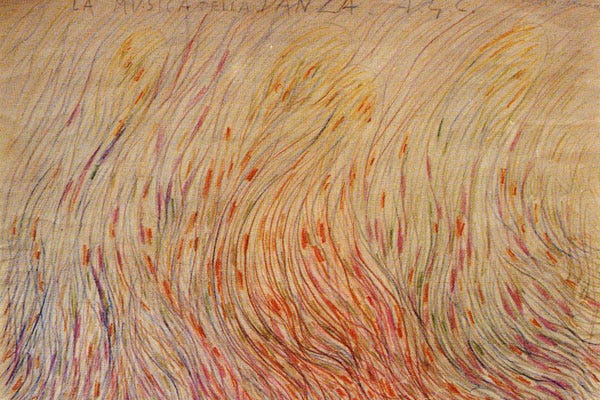
I will probably say a little more about Futurist cinema in later posts, because this necessitates jumping forward to the 1930s. We’re not “there” yet. So I’ll reconcile myself to talk about Ginna and Corra in a certain amount of depth, even if we don’t have access to what must have been their most original and striking cinematic works. They were also among the very first to experiment with abstraction in (canvas) painting, and you might get an impression of what Ginna was capable of by studying the above painting—a canvas finished some time in the first decade of the 20th century. It is dripping and swirling and “motional”; insofar as it conveys a frozen moment of sultry dynamism. We will have to imagine what a moving film-work, executed in this style, would have looked like; especially given that it would have been painted on the much more confined space of a film cell; and simplified too, given that the artists would have to paint and repaint the image, albeit differently, over and over again—many hundreds or even thousands of times.
The first tranche of their films—hand-painted abstractions—were made between 1911 and 1912. There were six of them; or, at least six of them are absolutely known to have existed at some point or another—bearing with them such titles as A Chord of Colour (1911), Study on the Effects of Four Colours (1911) and The Rainbow (1912).


Ginna would eventually join the Theosophical Society in 1913, drawn to the occult and esoteric themes he was beginning to gravitate toward in his paintings, which we must assume were carried over and replicated, given motion, in the films he later made with Corra; reflecting what for him had been “the true starting point of art”, “the descent of human spirituality towards the sensitive world”. Lucia Collarile suggests that Ginna painted “states of mind, in pure thought and pure colour, that resulted from a profound search for inwardness”.1 It was this search that saw him attempt to produce a “chromatic drama” through “the union of music, painting, literature, theatre and cinema”; which led directly to his efforts, with Bruno Corra, to “[apply] colour directly onto film”. It was only a little later, in 1912, during the busiest days of their collaboration, that Ginna introduced himself to the Futurist general staff in Milan. Much of the work that Ginna would later do was also lost, though we’re indebted to various personal accounts of the processes he worked through in order to “wield” his colours toward a “fantastic expressive synthesis”. In their place, we have fragments and studies and scraps. They point toward the motional, chromatic drama that his and Corra’s films would have embodied had they survived.
Later, in 1916, they produced another grander film called Vita Futurista. Roundly described as the “first Futurist film”—at least officially—it was commissioned by no less than Filippo Marinetti himself. It was an episodic film; a series of anti-narrative vignettes that “illustrated” the aims and ambitions of Futurism. It was destroyed only much later, in 1960; or it was “lost”. Its sequences were descriptive: “How the Futurist sleeps”, “The Sentimental Futurist”, “How the Futurist walks”.
It is also lost, though a handful of scruffy stills survive. Ghostly and fogged and imprecise; it’s difficult to intuit what each of them depicts. In them, there is something akin to the “movement photography” of the Futurist Bragaglia brothers, whose work sought to capture the dynamism and energy of the moving human body; as if we can intuit toward the lost Futurist film-world: an accordioned-electrical-smearing of the body jolting-dancing through its positions.
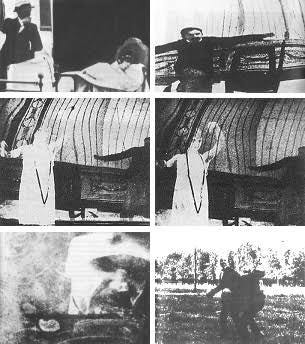
But Vita Futurista—perhaps because of its lost-ness—has a yet ghostlier affect than the Bragaglia photographs; where its foggy frames can only evoke a sense that they were encoded by another alien mind, strange and distant and unknown; or that they were the work of some secretive outsider artist, scrawling away with dry pen on tatters of paper in their unvisited rooms. Even then, Bragaglia’s thesis evinces perhaps nothing more than a wailing, insufficient desire for photography to be film:
“the resulting [...] photograph, achieved by experimental and other means, would succeed in registering the expression and the vibration of actual life, and in distancing itself from obscene, brutal, and static realism, and it would no longer be the usual photography”
A photograph, expressive and vibrating with “actual life”, that is “no longer [...] photography” feels like a theory for the film, albeit a theory of film without movement. Such were the paradoxes. Bragaglia was kicked out of the Futurist ranks in 1913 for heresies such as these. Corra and Ginna strove toward something much more vitial and moving. Their lot was to have most of their work destroyed by the same inhuman forces that their Futurist masters had so eagerly cheered on.
But these lost digressions and speculations come up against the one surviving Futurist film from this first, early period of Italian filmmaking. Thaïs—made by Bragaglia himself—exists today in a parlous print, scruffy and dim, but through which we can trace the promissory of the now-dissolved Futurist kino; showing that his efforts to create a filmic photography led him precisely and predictably to the doors of cinema itself. No surprises there, I should think.
The film itself is also a rather predictable love story centred on a wilful diva; a beautiful Slavic countess played by Thaïs Galitzy. Her great pleasure or compulsion (or both) is her desire to seduce married men, “dragging them to the brink of ruin”. Eventually, she seduces the lover of Bianca, her best friend, who—distraught on discovering this act of faithlessness—throws herself from her horse and dies. Thaïs, consumed by her own guilt, is subjected to a hypnotically surreal barrage of unreal images before she too takes her own life.
It is with no little irony that the eponymous Thaïs—dressed in an outfit so spectacular and erotic and strange that it will “drive the count crazy”, as the story goes—appears to us, in the blown-out raggedness of the film’s surviving print, as a blossoming smear of vapourous yellow. If this is the Futurist horizon then it’s an unintentional sleight of hand; the inverse entropic trajectory that ultimately afflicts even chemicals and machines. You could say: here’s the poison gas that, even then—in 1917—was groping its way across the battlefields of Flanders and Verdun. If that isn’t the Futurism that Marinetti and his engine-operator-artists ultimately clamoured for then I cannot say what is.


There is (allegedly) a print of the film that hasn’t been muddied and broken, but I’ve been unable to find it anywhere. In its place I’ve managed to find and study stills taken from this better, cleaner, less muddy print, but there are only a handful of them that seem to exist (which, ironically, are also in a muddled state of decay). We can see a film whose set design is very beautiful, sort of Diet Cocteau, sort of geometrically abstruse, the not-yet-modern man’s image of the “modern” (sharp corners, edges, repeating patterns, and – for some reason – squares).
In this light, Ginna and Corra’s lost cinema represents one of many similar narratives from the early years of film: a “lost” pathway that may have shaped film, but no longer forms a part of its record. But the cinema is a land of ghosts. It haunts us from time to time.
There’s a pretty useful article by Massimo Introvigne on this matter, “Around Giacomo Balla: Italian Futurists and Theosophy 2: Futurism and the Theosophical Society”, which can be read here.
Here, I’m indebted almost entirely singularly by Lucia Collarile’s text on Ginna Corra’s official website, which goes into abundant depth on his work, his Theosophical beliefs, and his relationship with Futurism.